7 Topics
 5 Days
 23 Sessions
Programme Overview
Training Description
Basic Life Support (BLS) training is essential for anyone who may encounter a medical emergency, spanning both healthcare and community settings:
1. Healthcare Professionals: Doctors, nurses, paramedics, emergency medical technicians (EMTs), dentists, pharmacists, and physical therapists.
2. First Responders & Public Safety: Police officers, firefighters, lifeguards, and security personnel.
3. Direct Care & Support Staff: Caregivers, nursing assistants, medical assistants, and dental hygienists.
4. Workplace Safety Teams: Designated workplace first-aiders, human resources safety coordinators, and industrial plant workers.
5. Community Members: Teachers, fitness trainers, childcare providers, and the general public seeking lifesaving emergency preparedness skills.
Session Objectives
- Recognise life-threatening emergencies, including sudden cardiac arrest, respiratory arrest, foreign-body airway obstruction, and severe trauma.
- Activate emergency response systems rapidly and efficiently, including retrieving and deploying an automated external defibrillator (AED).
- Perform high-quality cardiopulmonary resuscitation (CPR) with correct compression rate, depth, recoil, and ventilation ratios for adults, children, and infants.
- Operate an Automated External Defibrillator (AED) safely and effectively in conjunction with chest compressions.
About the Course
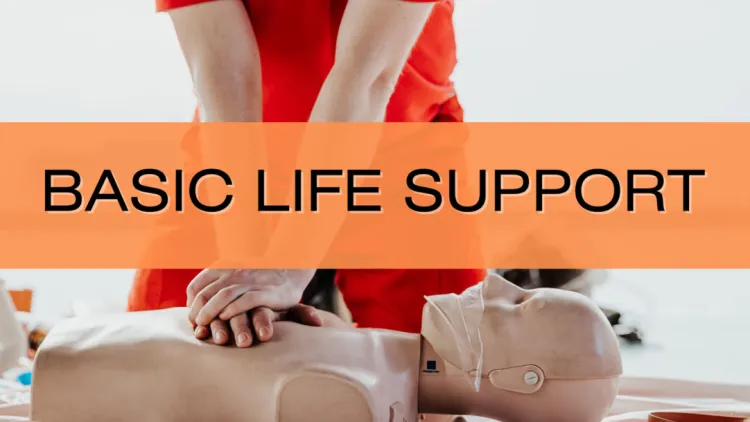
Welcome to the training on Basic Life Support (BLS).
Cardiovascular disease, trauma, and accidental injuries remain leading causes of emergency medical intervention worldwide. When sudden cardiac arrest occurs, every single minute counts: the probability of survival decreases by approximately 7% to 10% for every minute that passes without immediate cardiopulmonary resuscitation (CPR) and defibrillation.
Basic Life Support represents the foundational level of pre-hospital and in-hospital emergency care designed to sustain life until advanced medical help takes over or spontaneous circulation is restored. It focuses on immediate recognition of life-threatening events, prompt activation of the emergency response chain, high-quality chest compressions, early defibrillation, and effective airway management.
Why This Training Matters
Survival from cardiac arrest is rarely a matter of luck; it is a direct result of rapid, well-executed chain-of-survival actions by bystanders and trained responders. Historically, resuscitation guidelines have evolved to prioritize continuous, uninterrupted chest compressions to maximize vital organ perfusion.
This training bridges theoretical knowledge with muscle memory. By the end of this program, participants will possess the confidence, hands-on competence, and composure required to step forward and save a life when emergencies strike.
Curriculum & Topics
7 Topics | 23 Sessions
-
 Workshop 1.1:
The components of the Out-of-Hospital Cardiac Arrest (OHCA) and In-Hospital Cardiac Arrest (IHCA) Chains of Survival.
Workshop 1.1:
The components of the Out-of-Hospital Cardiac Arrest (OHCA) and In-Hospital Cardiac Arrest (IHCA) Chains of Survival.
-
Workshop 1.2:
Assessing scene safety, personal protection, and evaluating responsiveness.
-
Workshop 1.3:
Activating the emergency response system and summoning an AED.
-
Workshop 2.1:
Anatomy of cardiac arrest versus respiratory arrest.
-
Workshop 2.2:
Assessing breathing and checking carotid pulses.
-
Workshop 2.3:
Mechanics of high-quality adult CPR:
-
Workshop 3.1:
Understanding the role of early defibrillation in shockable rhythms (Ventricular Fibrillation and Pulseless Ventricular Tachycardia).
-
Workshop 3.2:
Step-by-step operation of an AED: power-on, pad placement, rhythm analysis, and safe shock delivery.
-
Workshop 3.3:
Special considerations for AED usage (water, implanted devices, hairy chests, pediatric pads).
-
Workshop 4.1:
Opening the airway using the head-tilt/chin-lift maneuver (and jaw-thrust maneuver for suspected trauma).
-
Workshop 4.2:
Delivering effective rescue breaths using barrier devices (pocket masks) and bag-valve-mask (BVM) devices.
-
Workshop 4.3:
Avoiding excessive ventilation and recognizing signs of adequate chest rise.
-
Workshop 5.1:
Key physiological differences in pediatric resuscitation.
-
Workshop 5.2:
Performing CPR on children (ages 1 to puberty) and infants (under 1 year).
-
Workshop 5.3:
Modifications in compression depth, technique (one-rescuer vs. two-rescuer, heel of hand vs. two-finger/two-thumb encircling technique), and pulse check locations (carotid vs. brachial).
-
Workshop 5.4:
Pediatric compression-to-ventilation ratios (30:2 for single rescuer; 15:2 for two-rescuer healthcare providers).
-
Workshop 6.1:
Recognizing mild versus severe airway obstruction.
-
Workshop 6.2:
Performing abdominal thrusts (the Heimlich maneuver) on responsive adults and children.
-
Workshop 6.3:
Managing choking in infants using back slaps and chest thrusts.
-
Workshop 6.4:
Handling a choking victim who becomes unresponsive.
-
Workshop 7.1:
Roles and responsibilities in a high-performance multi-rescuer resuscitation team.
-
Workshop 7.2:
Smooth transitions and swapping compressors without halting compressions.
-
Workshop 7.3:
Special considerations during resuscitation (e.g., opioid overdose recognition and naloxone administration, pregnancy, drowning, and trauma).